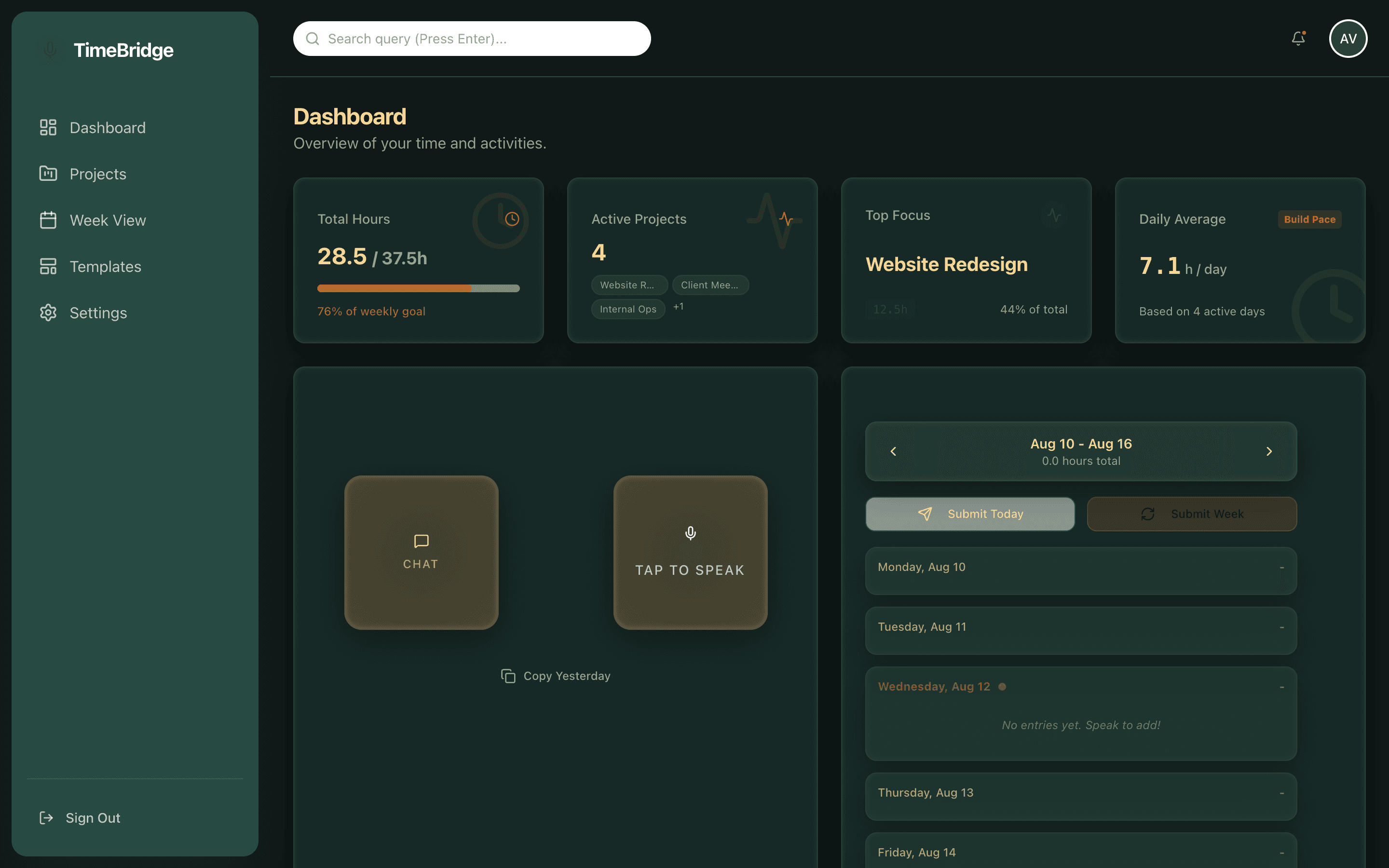
The dashboard: your week at a glance
AI Product / Voice Interface
TimeBridge AI
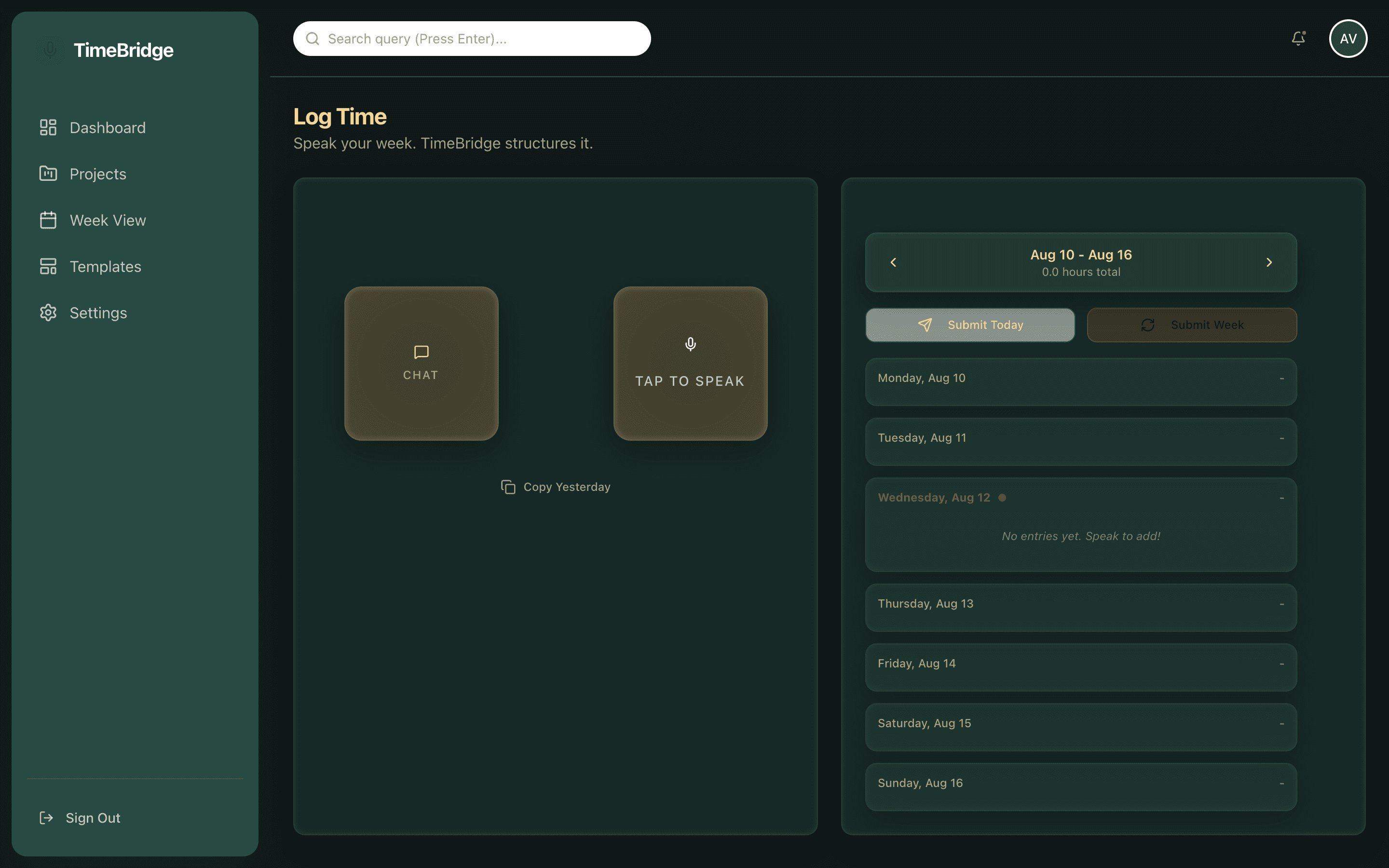
Our own voice-first time tracker for agencies on Deltek Maconomy: say what you worked on, and AI turns it into structured, code-mapped timesheet entries.
2
AI models in the pipeline
1 tap
To relog yesterday
0
Job codes to memorize
How we got this number
The client owns the tool outright: $6,000 up front and nothing to us after that. For their four consultants, an hour a week each at $100 is about $1,600 a month, $19,200 a year, so the build pays for itself in under four months on time alone. Same-day logging also recovers billable hours that Friday reconstruction misses: at 2% of roughly $600,000 in annual billings across four seats, that is another $12,000. About $31,200 of first-year value on a $6,000 build, a ~420% return.
~420%
12-month ROI
About TimeBridge AI
TimeBridge AI is our own product, built for a pain every agency on Deltek Maconomy knows: creatives and consultants who end the week reconstructing their hours against cryptic job codes like A205936-249. Time tracking is universally hated, so nobody does it until Friday, and the data suffers.
The Challenge
Logging time has to be faster than avoiding it. That means no forms as the default, no code lookups, and no trust falls: AI output has to be confirmed by a human before anything lands in the timesheet, and ERP credentials have to be stored safely.
What We Built
We built a voice-first pipeline with two AI models. Whisper transcribes what you say, and Claude structures it into entries, so "half a day on the Nike campaign" becomes 3.75 hours on the right project. Friendly aliases map to real Maconomy job codes with fuzzy matching, so "Nike project" still resolves. Every draft waits for a confirmation tap before it saves. Around that core: a week view with per-day sync status, templates for recurring entries, a one-tap "copy yesterday", and a menu bar mini app built with Electron so logging never means opening the ERP.
The Results
- Logging a day takes one spoken sentence instead of a form and a code lookup
- Spoken phrases like "half a day" parse to exact hours, and project names resolve to Maconomy codes automatically
- Nothing posts without a human confirmation tap, and every change is audit logged
- ERP credentials are encrypted at rest with AES-256
The Value, Calculated
Conservative estimates. The assumptions are part of the math.
Time it saves
~1 hr/week per seat
Logging a day in Maconomy means finding the right job codes and filling RPC forms: 10 to 15 minutes, which is exactly why nobody does it daily. One spoken sentence takes under a minute. Across five workdays that is roughly an hour per consultant per week, plus the Friday afternoon spent reconstructing the week from calendar archaeology.
Money it saves
~$400/month per seat
The hour a week comes out of billable people. At a conservative $100 per consultant hour, 4+ hours a month is $400+ per seat. For a 25 person agency on Maconomy that is around $10,000 a month in senior time spent fighting a timesheet UI.
Money it makes
~2% billables
Hours logged the same day are more complete than hours reconstructed on Friday, and unlogged work is unbilled work. When same day voice logging recovers even 2% of the billable time that reconstruction misses, a $2M agency books an extra $40,000 a year.
Return on investment
~420% in year one
The client owns the tool outright: $6,000 up front and nothing to us after that. For their four consultants, an hour a week each at $100 is about $1,600 a month, $19,200 a year, so the build pays for itself in under four months on time alone. Same-day logging also recovers billable hours that Friday reconstruction misses: at 2% of roughly $600,000 in annual billings across four seats, that is another $12,000. About $31,200 of first-year value on a $6,000 build, a ~420% return.
Want results like this?
Let's talk about what the same kind of system could do for your business.